Aerospace, defense and space components.

Aerospace work is low volume and high consequence. A scrapped blisk is not a scrapped part, it is weeks of lead time and a piece of billet nobody has a spare of. The machine has to hold size on part one and part fifty, in material that fights back.

Three things decide whether it does: whether the rotary axes are measured or inferred, whether the machine holds thermal position through a long cycle, and whether it is rigid enough to cut hard material without chatter.

Aerospace precision machining
Bladed geometry

Why an impeller is the honest test of a 5-axis machine
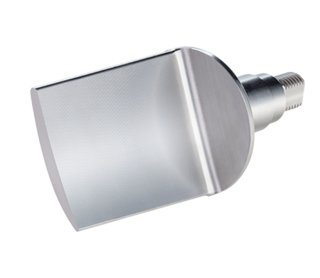
Turbine blade machined on a 5-axis machining center

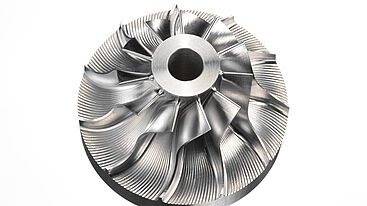
A bladed impeller demands full simultaneous five-axis contouring — all five axes moving together through the cut, not positioning and locking. That is the geometry that exposes whether a machine is genuinely rigid and thermally stable or merely has five axes. Hasegawa demonstrate it by cutting one on the PM320-5X; the same argument applies at larger sizes across the 5X range.

Blisks, integrally bladed rotors and compressor wheels all live here, and so does the reason five-axis pays: the part comes off complete, with no repositioning to lose datum between blade and hub.

5-axis simultaneousImpellers & blisksOne setupNo lost datum
Where the error comes from

Rotary error becomes dimensional error, and it compounds with part height

On a five-axis machine every fraction of a degree of rotary error shows up as a dimensional error at the tool — and the taller the part, the more it compounds. If the control infers rotary position from the servo and gearing, backlash and thermal growth go unmeasured.

The GEN MILL 5X machines carry glass-scale feedback on the rotary axes as well as the linear ones, so position is measured at the table rather than deduced from the motor. The 5X-24 adds scales on B and C alongside X, Y and Z; the 5X-12 and 5X-16 run glass scales on all five. That is the difference between a machine that is accurate when cold and one that is accurate at hour six.

Glass scales on B & CMeasured, not inferredRoller bearing ways0.0002″ / 12″
Hard material

Titanium, Inconel and the rigidity to cut them

Heat-resistant superalloys punish a machine that flexes. Roller-bearing linear ways — roughly twice as rigid as ball ways in the same envelope — run across the GEN MILL 5X range, with 300 PSI through-the-tool coolant to clear the flute rather than flood the part, and spindle chillers to hold thermal position through a long cycle.

Tooling matters as much as the machine here. Through North Shore Industrial Tool we supply the cutting tools and the application engineering alongside the machine, which is why the process recommendation is not automatically a bigger spindle.

Roller bearing ways300 PSI through-toolSpindle chillerHRSA tooling
Low volume, high consequence

Traceability and repeatability on parts you cannot rework

Space and defense work is often single-digit quantities where every piece is accountable. What matters is not throughput but whether the process is repeatable and provable: probing to verify setup before the cut, glass-scale feedback so position is measured, and tool and part probing included as standard on the PM320-5X.

Where the part genuinely cannot be held on a conventional machining center — optical-grade surfaces, micron form on hard material — the Shibaura UVM is the answer, and it measures its own tooling and workpiece as it goes.

Probing standardGlass-scale feedbackSingle-digit quantitiesNo rework
Machines that suit this work

Where to start

Common questions

Asked and answered plainly.

Do I need full 5-axis simultaneous, or is 3+2 enough?
It depends on the geometry. In 3+2 (also called 4+1) the rotary axes position the part and lock, then three linear axes cut — which handles most prismatic parts with features on several faces, and is simpler to program. Full simultaneous means all five axes move together during the cut, which is what bladed geometry, impellers and complex contoured surfaces require. The GEN MILL 5X machines run either way, so you are not paying for simultaneous capability you only occasionally need.
Why do glass scales on the rotary axes matter for aerospace work?
Without scales the control infers rotary position from the servo motor and gearing, so backlash and thermal growth go unmeasured. With glass scales, position is measured at the table itself. Every fraction of a degree of rotary error becomes a dimensional error at the tool, and it compounds as the part gets taller — which is exactly the situation on an impeller or a structural fitting.
What machine suits titanium and Inconel?
Rigidity and coolant matter more than spindle speed. Roller-bearing linear ways, 300 PSI through-the-tool coolant and a spindle chiller run across the GEN MILL 5X range. Tooling choice is at least as important as the machine — substrate, coating and toolpath strategy decide tool life in HRSA material, which is why we supply the cutting tools and application engineering alongside the machine.
Can aerospace parts be machined complete in one setup?
Often, and that is usually the real justification. Every repositioning is another chance to lose datum, another fixture and more work in progress. Five-axis milling handles bladed and contoured work complete; a twin-spindle turn-mill with Y and B axes finishes turned aerospace parts front and back in one cycle.
Do you support the process after the machine is installed?
Yes. Our application engineers stay involved after the sale on process improvement and continuous improvement — revisiting speeds and feeds, extending tool life, and taking cycle time out of jobs already running. Because we supply the cutting tools as well as the machine, that work does not stop at the boundary between two suppliers.
The tooling side

The machine is half of it. The other half is what cuts.

HRSA, titanium and thin-wall structures punish the tool before they punish the machine. NSIT runs the aerospace side — ceramics and BIDEMICS for nickel alloys, plus the workholding that keeps a thin wall from moving.

Aerospace & defence tooling

Ceramic and BIDEMICS inserts for HRSA, solid carbide for titanium and aluminium structure, and the application engineering to put them to work.

NSIT aerospace & defence →

HWR SOLIDStamp form-fit clamping

A stamping station presses a tooth contour into the blank outside the machine. The part clamps by form fit on a 3 mm edge, at low clamping pressure, in a vise with almost no collision contour — so the tool reaches five sides with shorter, stiffer tooling and the spindle never spends a minute cutting a fixture.

See SOLIDStamp on NSIT →
Keep looking

Send us the part.

Send a print and we will call you back the same day. Our application engineers stay involved after the sale too — process and continuous improvement, not just the install. Send a part or call 978-356-2500.

All machines  ·  Machine selector  ·  Lights-out machining  ·  Home