Turn-mill lathes, 42 mm to 3″ bar.

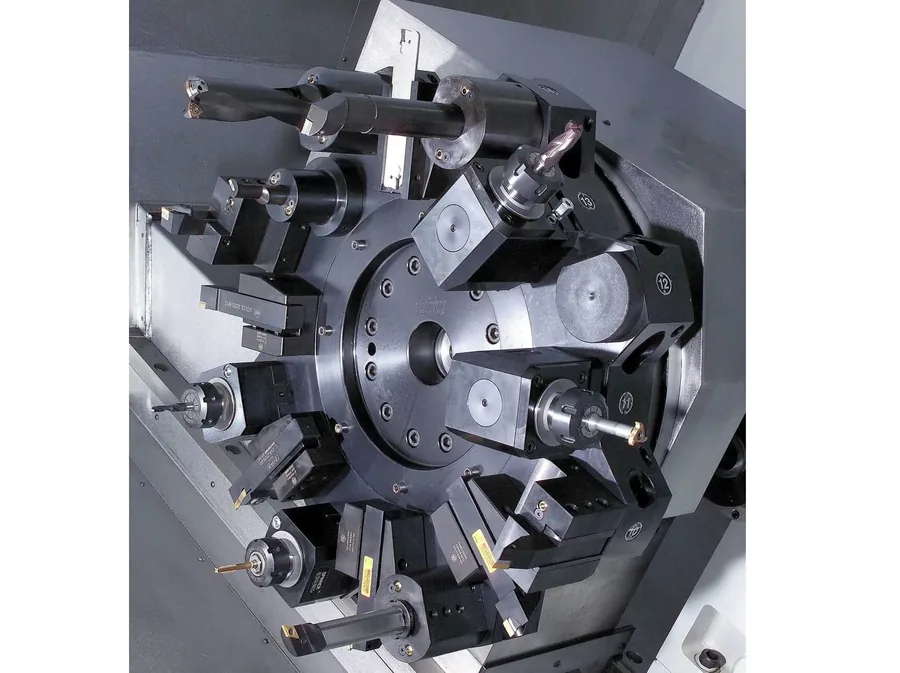
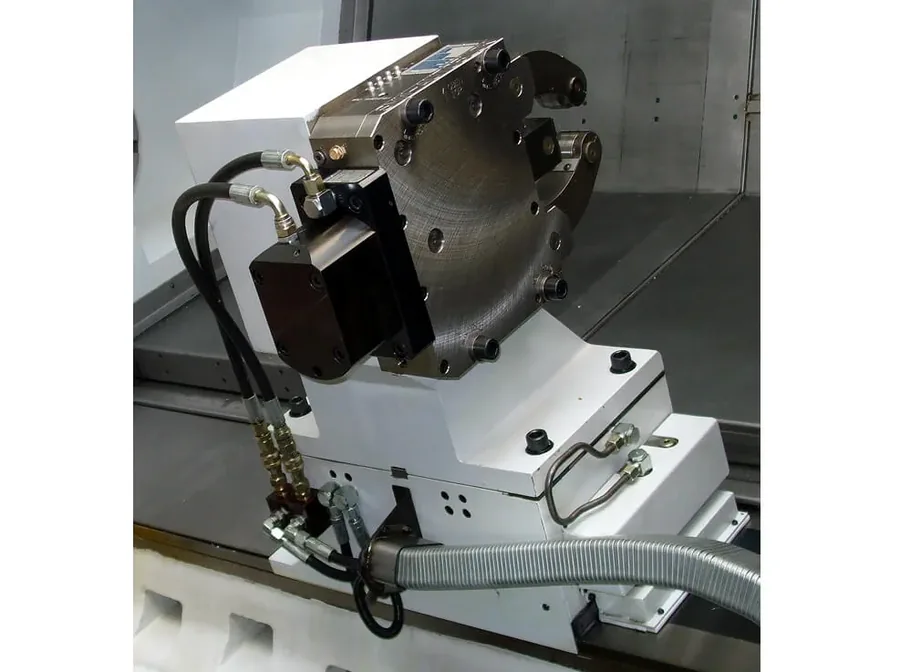
A turn-mill center holds the work in a chuck and brings driven tooling to it — often with a Y axis to mill off centerline, and on some machines a B axis to work at any angle. Where a Swiss lathe is built around long slender bar, a turn-mill is built around larger diameters, heavier cuts and complete front-and-back machining.

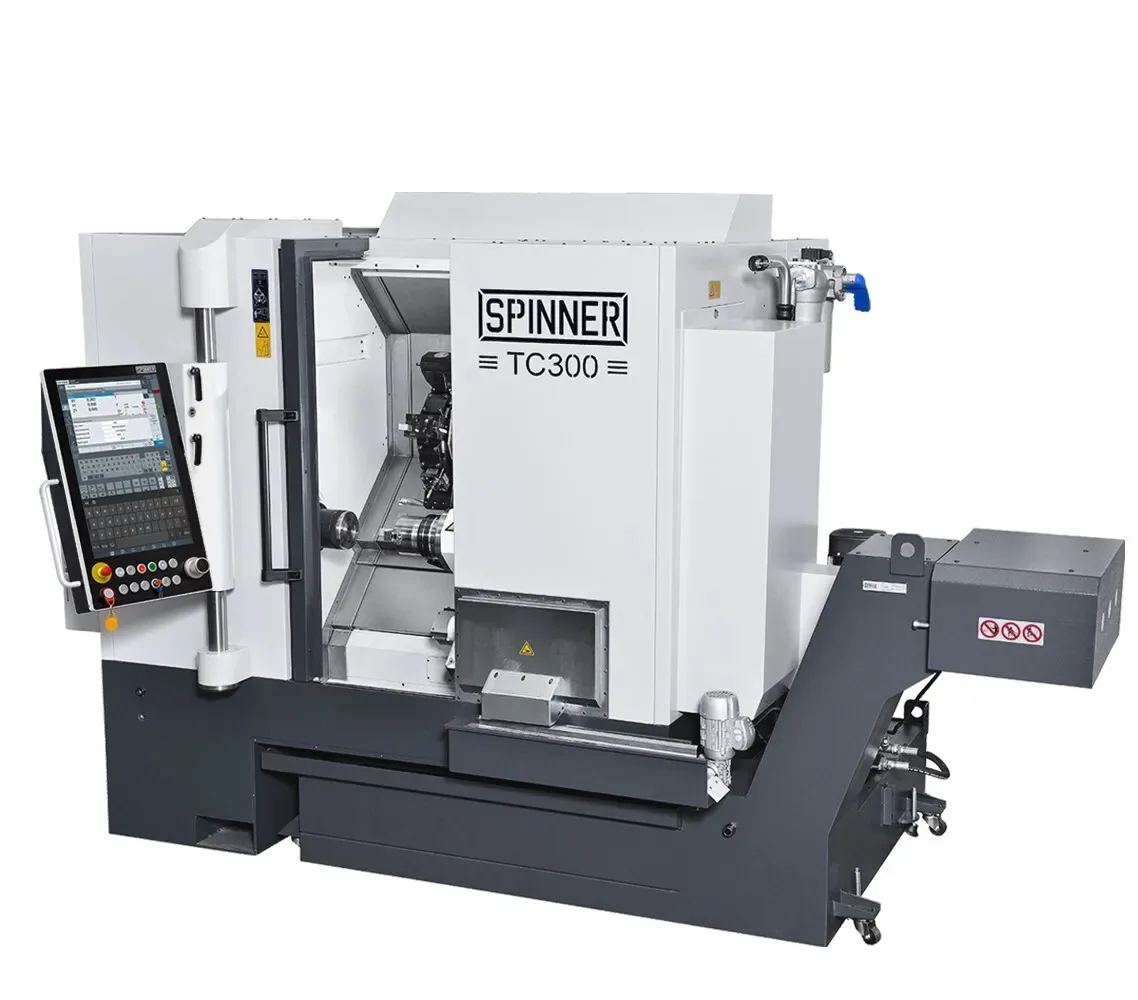
LOMA supplies seven GenTurn turn-mill machines, five of them built in Japan by Hasegawa Machine Works. Twin opposed spindles across the range, live turrets from 12 to 32 stations, and options that include a nine-axis B-axis machine and a twin-turret center with an integrated gantry loader.

CW52MY GIIGantry loader built in

Twin turret, dual Y, and the automation inside the machine
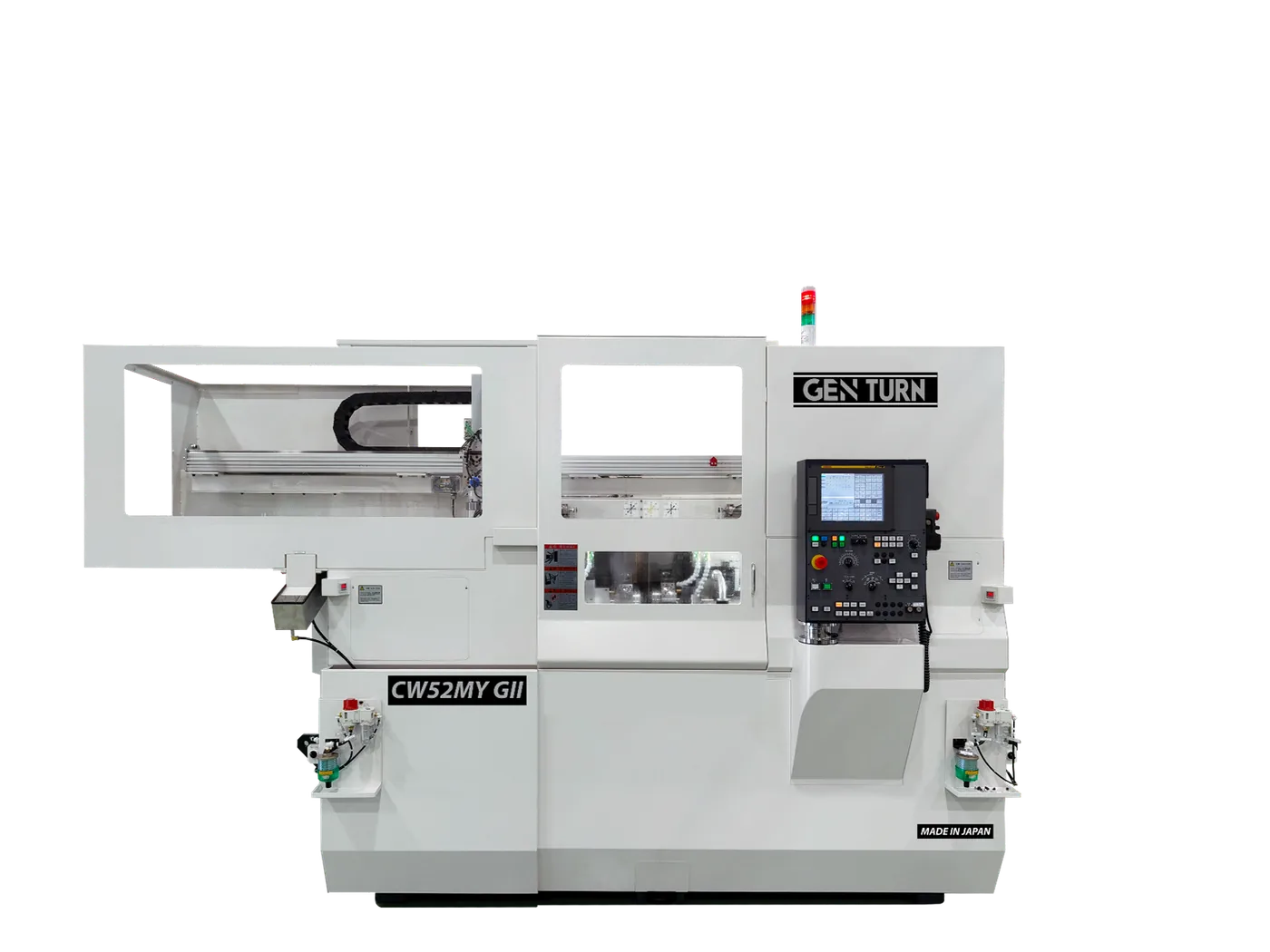
CW52MY GII — Twin turret, dual Y, and the automation inside the machine
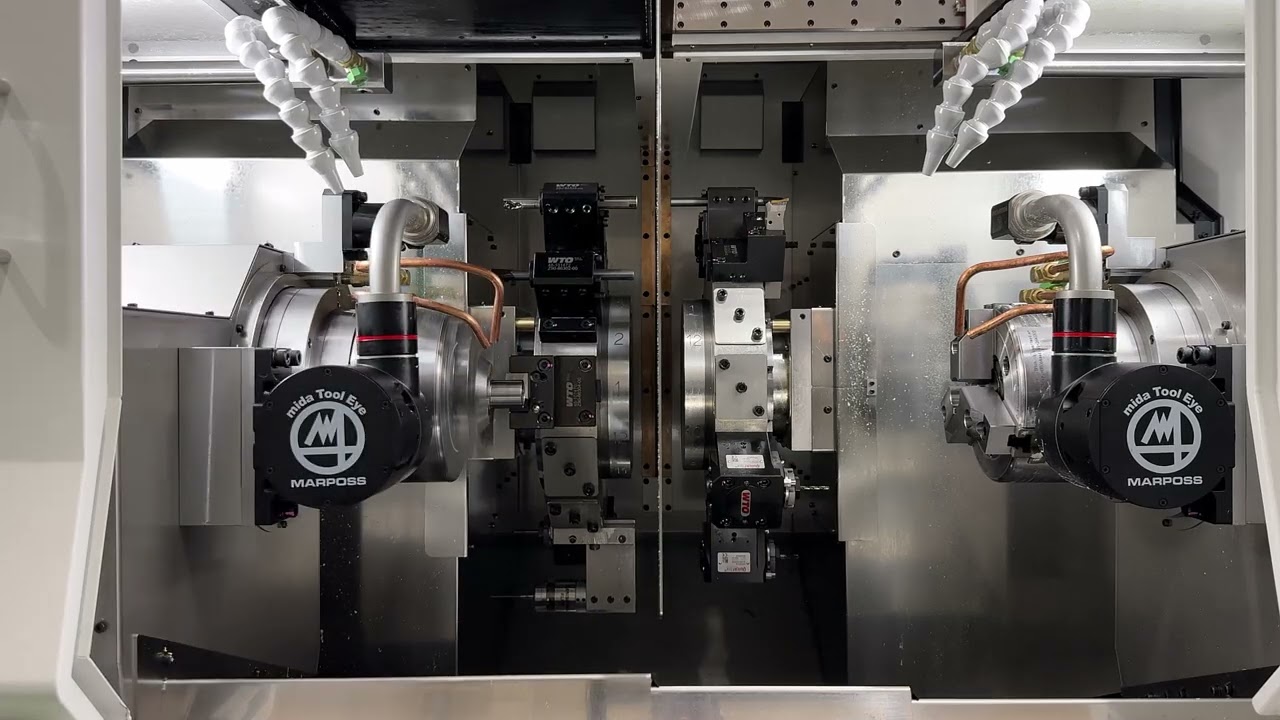
CW52MY GII
Hasegawa · continuous unattended production

Everything the CW52 MY does, with a three-axis rack-and-pinion gantry loader running overhead. It reaches both spindles, rotates the gripper under motor control, and handles workpieces to 3 kg. Because it is overhead, you give up no floor space beside the machine and have no cell to fence. Fanuc OiTF Plus control with Marposs motorised tool setters. Made in Japan.

Bar capacity
2.04″ · 52 mm
Spindles
5,000 RPM · 12 HP each
Turrets
2 × 12-station live
Gantry
3-axis · 3 kg payload
Rapids
787 ipm
Weight
11,220 lb
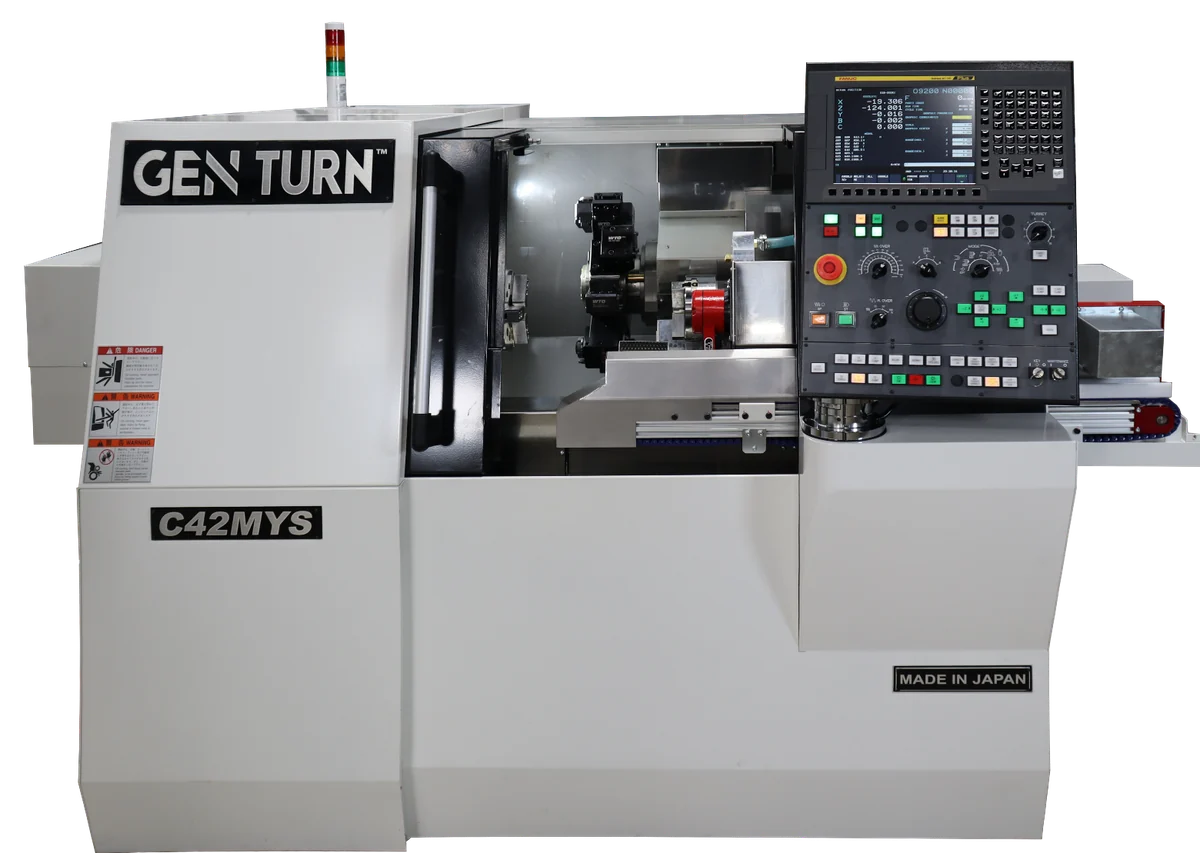
C42 MYSMade in Japan

6-axis mill/turn with milling on every turret station

GenTurn C42 MYS 6-axis mill/turn lathe, built in Japan
GenTurn C42 MYS
Expand Machinery · machine video

The smallest bar capacity in the turn-mill range, and the one where every turret station mills. Ten driven stations taking WTO Quick-Flex toolholders, indexing in 0.8 seconds on a hydraulic drive — so there is no live-tool position to plan around, because they all are. Dual-opposed spindles are fully synchronised for accurate transfer even across an irregular machined surface, with full C axis on both and a full Y axis on the turret for milling off centerline. A Marposs tool setter comes as standard for faster setups, and pressurised grease way-lubrication keeps coolant out of the ways. Built in Japan by Hasegawa Machine Works.

Bar capacity
1-5/8″ · 42 mm
Main spindle
6,000 RPM · 10 HP · A2-5
Sub spindle
6,000 RPM · 10 HP · A2-4
Turret
10 driven · 0.8 s index
Travels X / Z / Y
4.33 / 10.63 / ±1.18″
Weight
5,720 lb

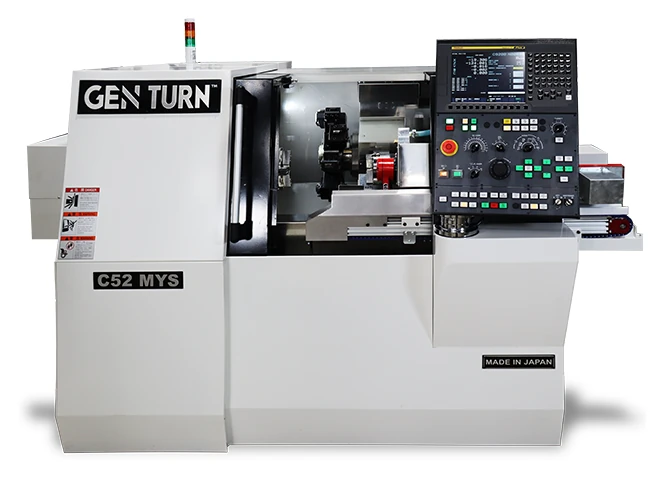
C52 MYS

6-axis twin spindle with a full Y-axis turret

C52 MYS — 6-axis twin spindle with a full Y-axis turret
GenTurn C52 MYS
Expand Machinery · machine video

The simpler sibling to the CW52 MY: twin built-in spindles and one 12-station BMT44 live turret with full Y. Front and back work finished in one cycle on 2″ bar, with a Marposs tool probe for fast setup and a parts catcher and conveyor included. Made in Japan.

Bar capacity
2.04″ · 52 mm
Main spindle
5,000 RPM · 12 HP
Sub spindle
5,000 RPM · 10 HP
Turret
12-station BMT44
Rapids
787 ipm
Weight
8,377 lb

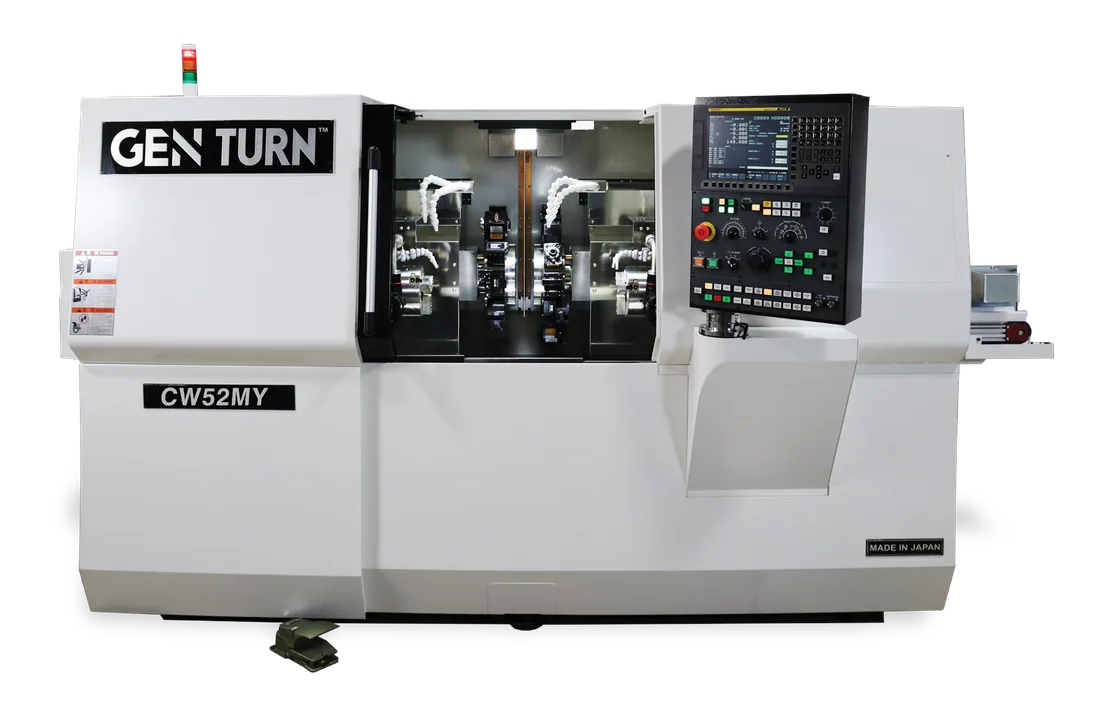
CW52 MY

8-axis twin spindle, twin turret, dual Y axis

CW52 MY — 8-axis twin spindle, twin turret, dual Y axis
GenTurn CW52 MY
Expand Machinery · machine video

Two 12-station BMT44 turrets, each with its own Y axis, over twin 12 HP built-in spindles. Parts transfer on the fly and both ends run at once — the shortest cycle in the family on complex 2″ work. Dual 135 PSI coolant, 6″ Kitagawa chucks, Marposs probing on each turret. Made in Japan.

Bar capacity
2.04″ · 52 mm
Spindles
5,000 RPM · 12 HP each
Turrets
2 × 12-station BMT44
Y travel
±1.18″ both turrets
Rapids
787 ipm
Weight
10,584 lb

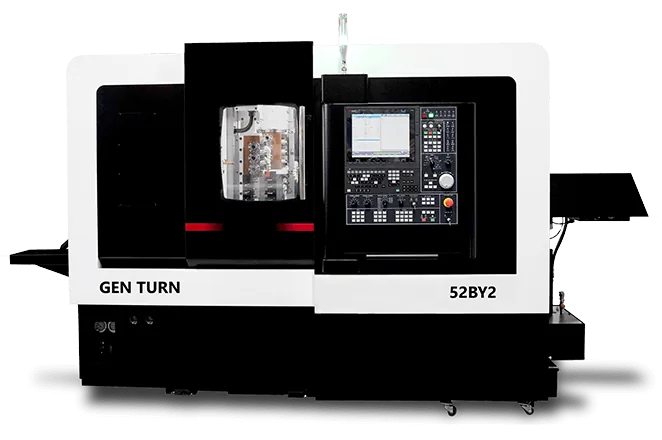
52-BY2B-axis

9-axis mill/turn with 12 tools on a programmable B axis

52-BY2 — 9-axis mill/turn with 12 tools on a programmable B axis
GenTurn 52-BY2
Expand Machinery · machine video

Live tooling fixed on centerline can only work square to the part. A programmable B axis swings the driven tool to any angle — angled holes, off-axis pockets, compound features — and here twelve B-axis tools serve both main and sub spindle. Thirty-six tool positions with eighteen driven, and dual Y for front and back work.

Bar capacity
2.008″ · 51 mm
Spindles
6,000 RPM · 15 HP peak
Tooling
36 positions / 18 driven
B axis
12 tools, any angle
Rapids
1,181 ipm
Weight
12,345 lb

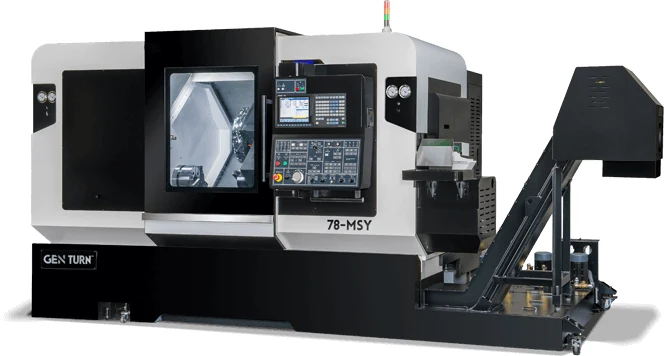
78-MSY

3″ bar, 16-tool live turret, complete front and back work

78-MSY — 3
GenTurn 78-MSY
Expand Machinery · machine video

The large-capacity machine in the range. Up to Ø12.79″ turning diameter and 22.04″ turning length, a 30 HP integral refrigerated main spindle, and a 16-station BMT-65 live turret indexing in 0.2 seconds between adjacent tools. Big turned-and-milled parts finished in one machine rather than three.

Bar capacity
3.07″ · 78 mm
Main spindle
4,000 RPM · 30 HP
Sub spindle
4,000 RPM · 15 HP
Turret
16-station BMT-65
B-axis travel
27.16″
Weight
17,650 lb

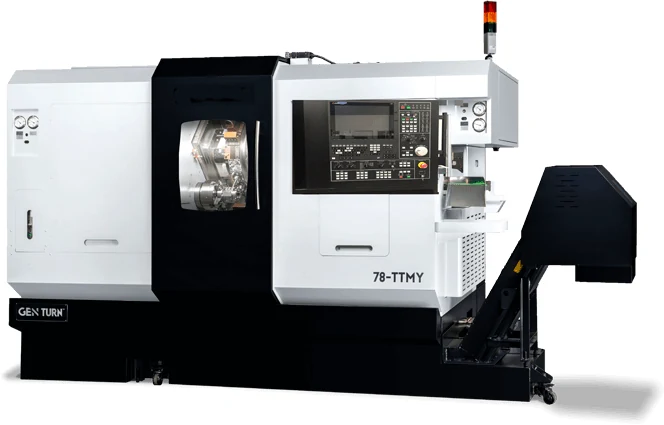
78-TTMY

8-axis with twin 16-tool turrets and glass scales

78-TTMY — 8-axis with twin 16-tool turrets and glass scales
GenTurn 78-TTMY
Expand Machinery · machine video

Thirty-two turret stations across two BMT-65 turrets, twin 4,000 RPM opposed spindles at 30 HP peak, and glass scale feedback on X¹ and X². Full C axis on both spindles with 360,000 radial positions, and a B axis giving 20.86″ of sub-spindle travel.

Bar capacity
3.07″ · 78 mm main
Spindles
4,000 RPM · 30/20 HP peak
Turrets
2 × 16-station BMT-65
Feedback
Glass scales X¹, X²
Turning dia.
Ø12.79″ max
Weight
22,751 lb
Questions

Worth asking before you buy.

What is the difference between a turn-mill center and a Swiss lathe?
A Swiss-type lathe slides the bar through a guide bushing so the material is supported millimeters from the tool, which suits long, slender, tight-tolerance parts. A turn-mill center holds the work in a fixed chuck and brings driven tooling to it, which suits larger diameters, heavier cutting and complete front-and-back machining. Bar capacity is the usual deciding factor: below about 32 mm a Swiss machine is normally the better answer, above 50 mm a turn-mill usually is.
What does a Y axis actually give me?
A Y axis lets driven tooling work off the centerline of the part. Without it, milled features have to sit on center — a flat, a cross hole through the middle. With Y you can mill pockets, flats and holes anywhere on the face or the diameter, which is often the difference between a part coming off complete and going to a mill for a second operation.
What is a B axis for?
A B axis rotates the driven tool itself, so it can cut at any angle rather than only parallel or perpendicular to the spindle. On the 52-BY2 twelve B-axis tools serve both spindles, so angled holes and compound features get machined while the bar is still in the collet. It is the difference between a five-sided part and a genuinely complete one.
Which of these can run unattended?
All of them can be automated, and the CW52MY GII arrives that way — a three-axis gantry loader mounted overhead, handling workpieces to 3 kg across both spindles, with no extra floor space and no cell to fence. LOMA also supplies collaborative robot cells and bar feeders for the rest of the range.
Which machines are built in Japan?
The C52 MYS, CW52 MY and CW52MY GII are built by Hasegawa Machine Works in Saitama, Japan, a builder founded in 1928 that has made only small precision machine tools since. They are imported, stocked and serviced in North America by Expand Machinery, and supplied and supported by LOMA.
One relationship

Machines from LOMA. Everything they run on from NSIT.

A turn-mill is only as fast as the tool change. NSIT supplies the live tooling, holders and application engineering that get the cycle where it should be.

Live tooling, holders and the crib

Quick-change live tooling, BMT and VDI holders, and the engineering to pull setup time out of a multi-axis cycle rather than adding it back.

NSIT live tooling →

Tooling, workholding and the crib

Our sister company North Shore Industrial Tool handles what the machine runs on — cutting tools, toolholding, workholding, metrology and a managed inventory program. Same people, same phone number, so the machine arrives with the tooling package already sorted.

What NSIT manages →
Keep looking

Send us the part.

Tell us the material, the tolerance and the volume and we will tell you which of these fits — or that none of them do. Get in touch or call 978-356-2500.

← All machines  ·  Home