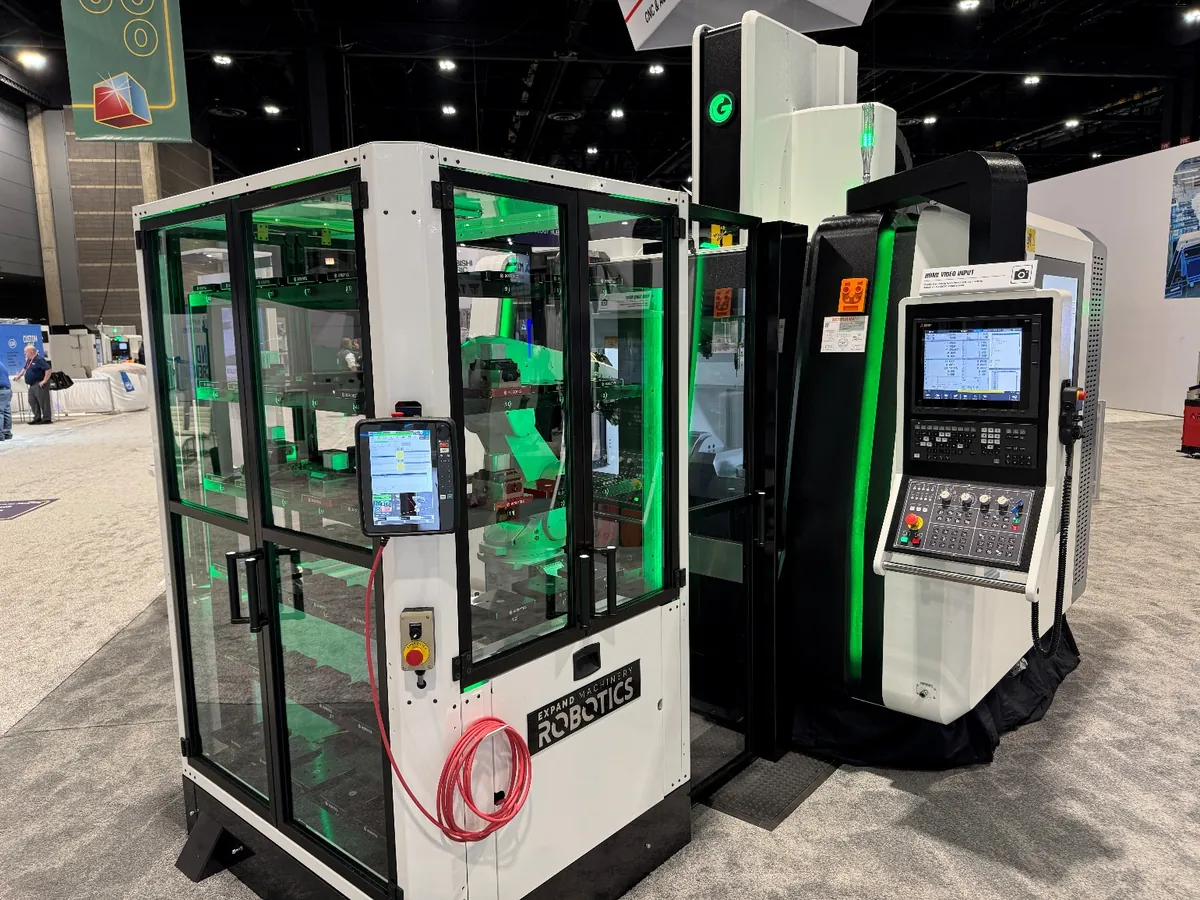
Running unattended: what it actually takes.

Every machine builder will tell you their machine runs lights out. Fewer will tell you what has to be true for that to hold on a Tuesday night in your shop, on your part, with your tooling.

There are four questions, and a machine has to answer all of them. How does the part get in and out. What fills up while nobody is watching. What notices when a tool breaks. And is there enough tooling to reach the end of the run. Get one wrong and you are not running lights out — you are gambling overnight.

The part has to get in and out

Load and unload without a person

This is the part everyone thinks of, and it has more than one answer. A bar feeder handles it for turned work — every lathe we supply takes one, and for a lot of shops that alone gets a machine through the night. Chucked work needs part handling: a collaborative robot beside the machine, or a loader built into it.

Built-in is usually better where it exists. The CW52MY GII carries a three-axis gantry loader overhead, reaching both spindles with a motor-driven gripper, handling parts to 3 kg — no floor space beside the machine and no cell to fence. The C24 G does the same for small turned parts with a twelve-station stacking magazine. Where the job needs a robot instead, we integrate one.

Bar feedersGantry loadersCollaborative robotsParts catchers
Chips and coolant

What fills up while nobody is watching

A cell that runs eight hours unattended makes eight hours of chips. Conveyors, wash-down and coolant capacity stop being convenience items and become the thing that ends the run early. It is worth sizing them deliberately: the GEN MILL machines carry 68 to 148 gallons depending on model, with chip conveyors and wash-down systems, and 300 PSI through-the-tool coolant to clear the flute rather than flood the part.

Thermal drift belongs in the same conversation. A machine that holds size at 8am and not at 2am has not really run unattended. Spindle chillers are standard across the GEN MILL range, and the Shibaura UVM circulates temperature-controlled liquid through the machine structure itself.

Chip conveyorsWash-down300 PSI TSCSpindle chillers
The tool that breaks at 2am

Something has to notice before the parts go bad

Unattended running fails badly rather than gracefully. A tool that chips at hour two does not stop the machine — it makes four hundred bad parts and hands you a scrap bill in the morning. Tool life management, load monitoring and probing are what turn a long run from a gamble into a process.

The clearest example in our line is the Shibaura UVM. It measures its own cutter contour during rotation, checks spindle displacement, and if it detects dynamic run-out it re-clamps the tool and tries again rather than cutting the error into the workpiece. At nanometer scale an unnoticed tool problem ruins the part — so self-measurement is not a luxury, it is the precondition for running without an operator.

FormEye tool contourShapeEye workpieceRun-out retryProbing
Enough tools to finish

Capacity to reach the end of the run

A program that runs out of cutters at hour six was never a lights-out program. Tool capacity and sister tooling decide how long a machine can actually go: 60 tools on the GEN MILL 5X-16 and 5X-24, 48 on the HSD-1000, 41 positions with 13 driven on the SL-32ABY, 32 driven stations across the twin turrets of the 78-TTMY.

Tooling choice matters as much as count. Cycle time is a tooling problem at least as often as a machine problem, which is why we work both sides of it — machine, workholding and cutting tools from one source rather than three suppliers pointing at each other.

60-tool ATCsSister toolingWorkholdingCutting tools
Machines built for it

Where automation is part of the machine

Not every machine needs a cell built around it

Some of these arrive with the handling already integrated. Others are the platform a cell gets built around. Which one suits depends on the part, the volume and how often the job changes.

Common questions

Lights-out machining, answered plainly.

What does “lights out” actually mean in a machine shop?
Running production with no operator present — typically overnight or through a weekend. It is a spectrum rather than a switch: some shops run one machine through a night shift on a bar feeder, others run a fenced cell for a full weekend. What separates a real lights-out process from an optimistic one is whether something detects a problem and stops before it scraps the whole run.
What is the difference between a bar feeder and a part loader?
A bar feeder pushes bar stock into a lathe spindle so the machine keeps cutting part after part from continuous material — the standard answer for turned work. A part loader handles discrete pieces: it picks a blank, puts it in the chuck, takes the finished part out. Bar feeders are simpler and cheaper; part loading is what you need for chucked work, second operations, or anything not made from bar.
Do I need a robot to run unattended?
Not always. For bar work a bar feeder and a parts catcher often cover it. Where a robot or loader is needed, built-in beats bolted-on when it exists — the CW52MY GII carries a three-axis gantry loader overhead, which costs no floor space and needs no cell fencing. A collaborative robot is the flexible answer where parts change often or the machine was not built with a loader.
What usually stops an unattended run?
In practice: chips or coolant, a broken tool nobody noticed, running out of tools, thermal drift moving the part out of tolerance, or a part that did not seat correctly. Every one of those is addressable, and each is worth designing for before you buy rather than after the first scrapped night.
Can precision work run unattended, or only roughing?
Precision work runs unattended when the machine can verify itself. The Shibaura UVM is the clearest case: it images its own cutter contour while it spins, measures spindle displacement, and re-clamps the tool when it detects run-out rather than machining the error into an optical mould. Accuracy and unattended running are not opposites — they meet where the machine measures its own condition.
How do I know if a job is a good candidate?
Repeatable setups, predictable tool life, stable material and enough volume to justify the runtime. The honest test is whether you can describe what would go wrong and how the machine would catch it. Send us the part and we will tell you what it would take — including if the answer is that this particular job is not a candidate yet.
The other half of lights-out

A machine that runs unattended still runs out of tooling.

Lights-out fails on the consumable, not the spindle. NSIT runs vending, bin stock and predictive reorder so the crib refills itself instead of stopping the shift.

Managed inventory & vending

SupplyPoint vending, bin stock and predictive reorder run as a program — so the second and third shift never wait on a tool that should have been there.

NSIT inventory management →

Tool life and process stability

Unattended running needs predictable tool life. NSIT’s application engineers set the parameters and the change intervals so the cycle survives the night.

NSIT application support →
Keep looking

Send us the part.

Tell us the part, the volume and how long you want it to run without someone standing there. We will tell you what it would take — including if the honest answer is that this job is not ready for it yet. Send a part or call 978-356-2500.

← All machines  ·  Machine selector  ·  Home