CNC Swiss lathes, 20 mm to 2″ bar.

Swiss-type sliding-headstock lathes supply the bar through a guide bushing so the material is supported within millimeters of the cut. That is what lets a long, slender, tight-tolerance part come off complete in one cycle instead of moving between three machines.

LOMA supplies five GenTurn Swiss machines covering 20 mm to 51 mm bar — guide-bushing, guide-bushing-less and hybrid builds that run either way — with driven tooling on every model and a programmable B axis on the newest. Sold, installed and supported across the Northeast and beyond.

SL-32ABYNew for 2026

32 mm hybrid Swiss with a full “B” axis
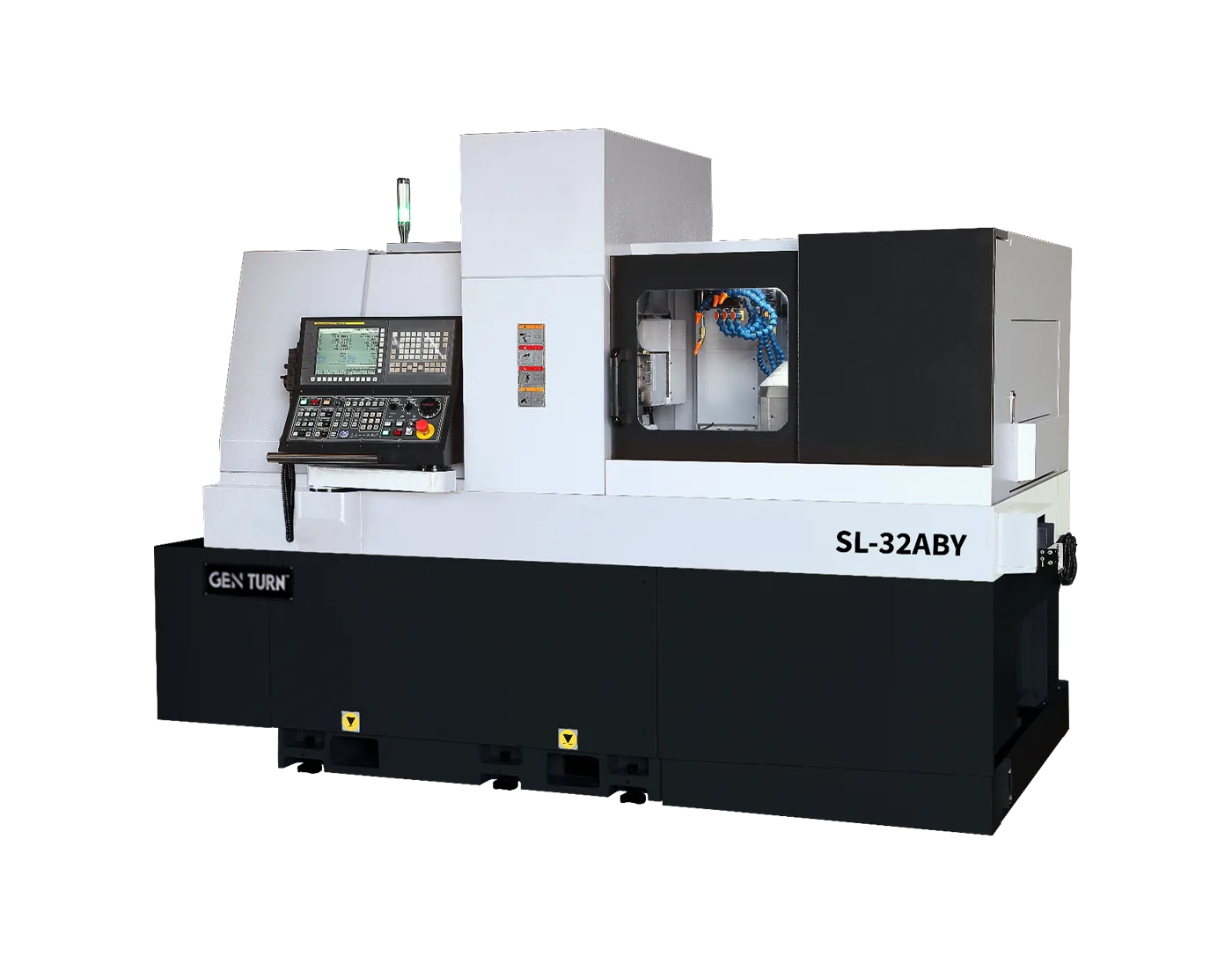
GenTurn SL-32ABY CNC Swiss lathe
GenTurn SL-32ABY
Expand Machinery · machine video

Four fully programmable B-axis live tools work at any angle — axial, radial and everything between — on both main and sub spindle. Run 32 mm bar with the rotary guide bushing for long slender work, or pull it and run chucker-style to kill remnant waste on short parts.

Bar capacity
1.259″ · 32 mm
Spindles
6,000 RPM · 7.5 HP each
Tooling
41 positions / 13 driven
B-axis
4 × ER-16 at 5,000 RPM
Turning length
10.23″ with bushing
Weight
10,960 lb
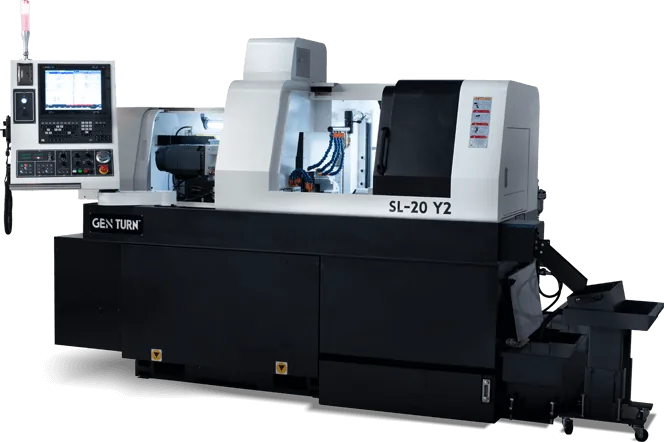
SL-20Y2Highest RPM

20 mm bar at 10,000 RPM

GenTurn SL-20Y2 CNC Swiss lathe
GenTurn SL-20Y2
Expand Machinery · machine video

The small-part machine. A 10,000 RPM main spindle with a removable rotary synchronous guide bushing, double Y and double C axis, 30 tools with 8 driven, and a cutting-oil chiller for thermal stability through a long unattended run.

Bar capacity
0.79″ · 20 mm
Main spindle
10,000 RPM · 5 HP
Sub spindle
8,000 RPM · 5 HP
Tooling
30 positions / 8 driven
Rapids
944 ipm
Weight
5,954 lb

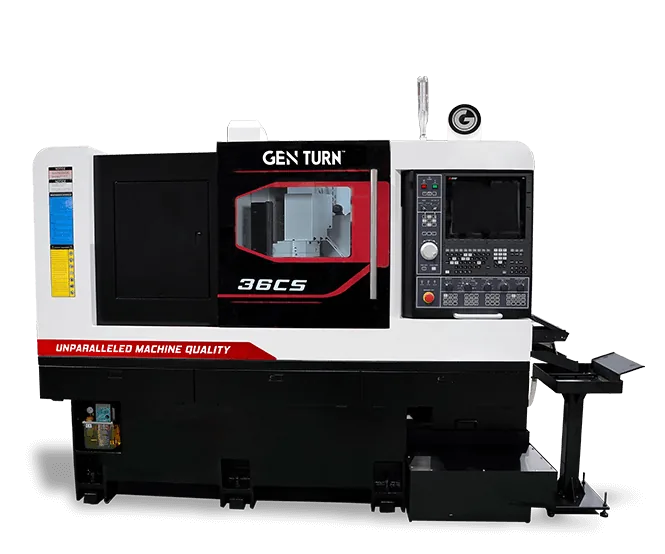
36-CSGuide-bushing-less

36 mm bar with 19″ of true Y travel

GenTurn 36-CS CNC Swiss lathe
GenTurn 36-CS
Expand Machinery · machine video

Runs without a guide bushing, so short parts don’t leave a remnant and bar stock doesn’t need to be ground. Dual C axis, 27 tools with 11 driven, and 1,181 IPM rapids.

Bar capacity
1.375″ · 36 mm
Spindles
6,000 RPM · 10.6 HP each
Tooling
27 positions / 11 driven
Y travel
19.3″ true Y
Rapids
1,181 ipm
Weight
8,818 lb

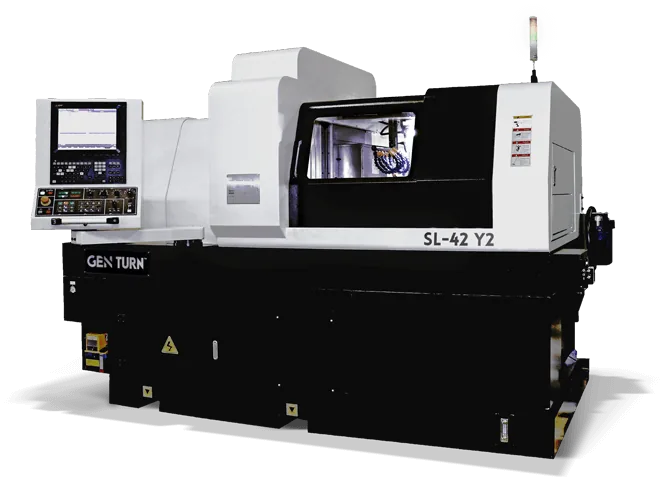
SL-42Y2Largest bar

1-5/8″ bar capacity, hybrid guide bushing

GenTurn SL-42Y2 CNC Swiss lathe
GenTurn SL-42Y2
Expand Machinery · machine video

The largest bar in the sliding-headstock range. Optional rotary synchronous guide bushing, double Y and double C, 33 tools with 9 driven, Mitsubishi M-830 control.

Bar capacity
1.65″ · 42 mm
Spindles
6,000 RPM · 10 HP each
Tooling
33 positions / 9 driven
Turning length
12.20″ with bushing
Rapids
944 ipm
Weight
11,024 lb

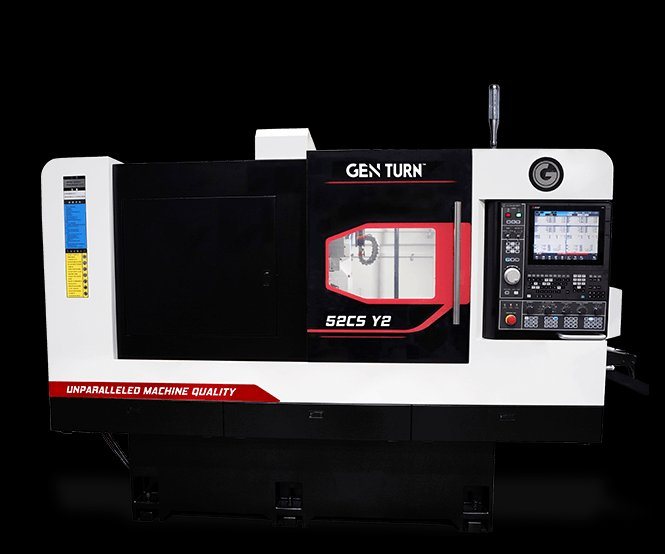
52-CS Y2Largest capacity

2″ bar, no guide bushing, full Y on both spindles

GenTurn 52-CS Y2 CNC Swiss lathe
GenTurn 52-CS Y2
Expand Machinery · machine video

The largest-capacity Swiss in the range. True Y-axis on main and sub — 24.41″ of Y¹ travel, not a compound approximation — with 33 tool positions and 13 live tools, all gear driven on Ø42 mm bearings rather than belts.

Bar capacity
2.00″ · 51 mm
Spindles
6,000 RPM · 15 HP each
Tooling
33 positions / 13 driven
Y¹ travel
24.41″
Cut length
14″
Weight
13,880 lb
Chip control · Mitsubishi VCC

Stringy chips are not a nuisance. They are the reason the lights go back on.

A Swiss machine will run unattended all night until one long chip wraps the tool. Then it makes scrap until somebody walks past. Stainless, titanium and free-machining brass are the usual culprits, and the usual fixes — peck cycles, geometry changes, slowing the feed — all cost cycle time on every part to solve a problem that happens on some of them.

Mitsubishi Vibration Cutting Control breaking chips on a GenTurn Swiss lathe
Vibration Cutting Control
Expand Machinery · VCC chip breaking

Break the chip from the program, not the geometry

Mitsubishi’s Vibration Cutting Control oscillates the Z1 and Z2 axes on command. G8.5 P2 sets the frequency and intensity, so the chip breaks where you tell it to — on the features that need it, at the feed you actually want, and nowhere else in the program.

The result is no chip nest forming around the tool or the part, which is what turns an unattended shift into a pile of scrap and a re-setup. It runs on our Swiss machines fitted with a rotary guide bushing, including the SL-20Y2.

Read Expand’s VCC announcement →

G8.5 P2

Frequency and intensity called from the program, per operation

Z1 & Z2

Oscillation on both axes — main and sub spindle work alike

Rotary bushing

Available on machines running a rotary guide bushing

No nests

Keeps chips off the tool and the part through an unattended shift

Quote or information

Quote this machine, or send me information.

Pick the machine and tell us what you need. A quote comes back with price, lead time and the options that fit; information comes as the brochure, specifications and videos. Same people, usually the same day. Or call 978·356·2500.

I would like
Swiss machining questions

Guide bushing or not? And other things worth asking.

What is a Swiss-type lathe?
A Swiss-type, or sliding-headstock, lathe moves the bar stock through a guide bushing while the tools stay fixed in Z. Because the material is supported within a few millimeters of the cutting tool, deflection is almost eliminated — which is what allows long, slender, tight-tolerance parts to be turned complete in a single cycle. Conventional lathes hold the bar in a chuck and cantilever it out toward the tool, so accuracy falls off as the part gets longer.
What does “guide-bushing-less” mean, and when do I want it?
A guide-bushing-less Swiss machine can run with the bushing removed, gripping the bar in the spindle directly. You lose the deflection support for long slender work, but you gain two things: no bar remnant left behind at the end of each bar, and no requirement for precision-ground bar stock. For short parts in expensive material — titanium, Inconel, medical-grade stainless — that saving is usually larger than the accuracy you give up. The 36-CS and 52-CS Y2 run without a bushing; the SL-32ABY, SL-20Y2 and SL-42Y2 are hybrids that run either way.
What bar sizes do these Swiss machines cover?
20 mm through 51 mm — roughly 0.79 inch to 2 inches. SL-20Y2 at 20 mm, SL-32ABY at 32 mm, 36-CS at 36 mm, SL-42Y2 at 42 mm, and 52-CS Y2 at 51 mm.
Can a Swiss machine do milling as well as turning?
Yes. Every machine in this range carries driven live tooling — from 8 driven positions on the SL-20Y2 to 13 on the SL-32ABY and 52-CS Y2. With a Y axis you can mill off centerline, and on the SL-32ABY a programmable B axis swings the driven tool to any angle, so angled holes and compound features get cut while the bar is still in the collet instead of going to a mill for a second operation.
Do these machines run unattended?
They are built for it. Bar feeders, parts catchers and conveyors are standard or available across the range, and cutting-oil chillers hold thermal position through long runs. LOMA also supplies robotic and gantry automation for load and unload where a part needs it.
One relationship

Machines from LOMA. Everything they run on from NSIT.

Small-diameter work eats tooling. North Shore Industrial Tool, the tooling side of our team, runs the Swiss side — micro end mills, guide bushings, coolants and the managed program that keeps a lights-out Swiss cell fed.

Swiss-type tooling and the crib

Micro end mills, guide bushings, coolants and inspection — specified for the part, not the catalogue, and stocked on a program so the cell keeps running overnight.

NSIT for Swiss-type →

Tooling, workholding and the crib

North Shore Industrial Tool, the tooling side of our team, handles what the machine runs on — cutting tools, toolholding, workholding, metrology and a managed inventory program. Same people, same phone number, so the machine arrives with the tooling package already sorted.

What NSIT manages →
Keep looking

Send us the part.

Tell us the material, the tolerance and the volume and we will tell you which of these fits — or that none of them do. Get in touch or call 978-356-2500.

← All machines  ·  Turn-mill lathes  ·  Home