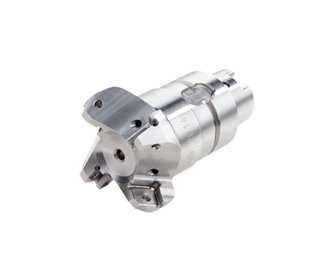
Medical and orthopedic components.

Medical work is slender, tight-toleranced and cut from material you cannot afford to waste. A bone screw is a long thin part with a thread, a drive feature and a tapered head — and it is made from titanium or cobalt-chrome that costs more per pound than the machine time.

Two decisions shape the process: how the bar is supported while it is cut, and how much of it ends up as remnant. Get those right and the part comes off complete.

Medical & orthopedic precision machining
Why Swiss

Support the bar within millimeters of the cut
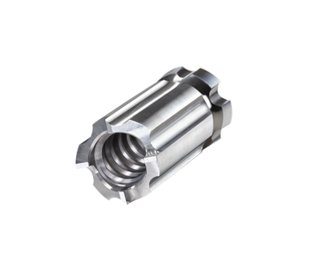
Precision medical component machined on a Swiss-type lathe

A Swiss-type lathe slides the bar through a guide bushing so the material is supported a few millimeters from the tool. That is what lets a part with a high length-to-diameter ratio be turned without deflection — the reason bone screws, pins and instrument shafts are Swiss work rather than chucker work.

Because the sub spindle picks the part up and back-works it, the thread, the drive recess and the head form can all be finished in one cycle. The part comes off complete rather than moving to a second machine with another chance to lose concentricity.

Sliding headstockHigh L:D ratioBack workingComplete in one cycle
The remnant question

In titanium, the bar you throw away is the cost

A guide bushing needs bar to hold onto, so every bar leaves a remnant — and it requires precision-ground stock, which costs more per foot. On steel at volume that is noise. On titanium, cobalt-chrome or implant-grade stainless it is real money leaving the building.

Guide-bushing-less machines grip the bar in the spindle directly: no remnant, and no requirement for ground bar. You trade some support on very long slender work. The 36-CS and 52-CS Y2 run without a bushing; the SL-32ABY, SL-20Y2 and SL-42Y2 are hybrids that run either way, so the same machine can take both kinds of job.

No bar remnantNo ground stock neededHybrid machinesExpensive material
Off-centerline features

Flats, cross holes and angled drive features

Medical parts rarely stop at turning. Hex and star drive recesses, cross holes, cannulation and flats all need driven tooling, and most need it off the centerline — which means a Y axis. Every Swiss machine in our range carries live tooling, from 8 driven positions on the SL-20Y2 up to 13 on the SL-32ABY and 52-CS Y2.

Where features sit at compound angles, the SL-32ABY adds four fully programmable B-axis live tools working at any angle on both main and sub spindle — so what used to be a milling operation happens while the bar is still in the collet.

Y axis13 driven toolsB axis at any angleCross drilling & tapping
Instruments and implant geometry

When the part is not a turned part

Not all medical work is bar work. Instrument bodies, trays, bone plates and implant geometry are milled — often five-axis, often in the same hard materials. The PM320-5X handles small precision five-axis work with a 25,000 RPM built-in spindle and probing as standard, and the larger 5X machines take it from there.

At the finest end, the Shibaura UVM produces microfluidic chip moulds with channels 50 to 150 µm wide, held to a micron with 2–5 nm Ra surfaces — diagnostics and micro-optical work that has no conventional alternative.

5-axis millingMicrofluidic moulds2–5 nm RaProbing standard
Machines that suit this work

Where to start

Common questions

Asked and answered plainly.

Do I need a guide bushing for titanium bone screws?
Not necessarily, and often you are better off without one. A guide bushing gives support for long slender work, but it leaves a bar remnant on every bar and requires precision-ground stock. In titanium or cobalt-chrome that waste is expensive. Guide-bushing-less machines grip the bar in the spindle directly — no remnant, no ground bar. Hybrid machines run either way, so one machine covers both cases.
What length-to-diameter ratio can a Swiss lathe hold?
Far more than a chucker, because the material is supported within a few millimeters of the cutting tool rather than cantilevered out of a chuck. The practical limit depends on material, feature geometry and whether you are running with or without a guide bushing. Send us the print and we will tell you what it will take rather than guess at a ratio.
Can the drive recess and cross holes be done on the same machine?
Yes — that is the point of live tooling and a Y axis. Every Swiss machine in our range carries driven tooling, from 8 driven stations up to 13. Y-axis machines mill off centerline for flats and cross features. Where features sit at compound angles, the SL-32ABY carries four programmable B-axis live tools that work at any angle on both spindles.
What about microfluidic and diagnostic tooling?
That is Shibaura UVM territory. Published results include a microfluidic chip mould in electroless nickel-phosphorus with channels 50 to 150 micrometers wide, held to a micron with a 2 to 5 nanometer Ra surface, cut with a 0.2 mm single-crystal diamond tool. Conventional machining centers are not built to reach that.
Can medical production run unattended?
Bar-fed Swiss work is one of the best candidates for it — consistent material, repeatable setup and long runs. Bar feeders, parts catchers and conveyors are standard or available across the range. What decides it is tool life management and whether something catches a problem before it makes a shift's worth of bad parts.
Do you help after the machine is running?
Yes. Our application engineers stay involved on process improvement and continuous improvement after the sale — speeds and feeds, tool life, removing setups and taking cycle time out of jobs you are already running.
The tooling side

Implant tolerances start at the cutting edge.

Bone screws, plates and instruments are small, hard and unforgiving. NSIT runs the medical side — micro tooling for Swiss work, plus workholding that holds a delicate part without deforming it.

Medical & orthopedic tooling

Micro end mills and hexalobe form tools for bone screws, Swiss-type tooling, and the metrology to prove the part.

NSIT medical & orthopedic →

Workholding for delicate parts

HWR INOFlex VL clamps round, cubic and thin-walled parts concentric at low clamping pressure — holding force without squeezing the part out of shape.

HWR workholding →
Keep looking

Send us the part.

Send a print and we will call you back the same day. Our application engineers stay involved after the sale too — process and continuous improvement, not just the install. Send a part or call 978-356-2500.

All machines  ·  Machine selector  ·  Lights-out machining  ·  Home